Clinical application of dog-assisted therapy – benefits for patients, healthcare professionals, and dogs: A review article
DOI:
https://doi.org/10.51607/22331360.2026.75.2.102Keywords:
Bosnia and Herzegovina, dog-assisted therapy, dog welfare, healthcare professionals, healthcare workersAbstract
A significant number of recent studies confirm the application of dogassisted therapy in healthcare institutions. Dog-assisted therapy, as part
of animal-assisted therapy (AAT), is increasingly gaining importance
in clinical practice, both in working with patients and in supporting
healthcare professionals. This systematic review analyzes 20 studies
published between 2025 and 2026, with a focus on dog-assisted
interventions in healthcare institutions involving various populations.
The search was conducted in the PubMed, Google Scholar, and
ScienceDirect databases. The selection process followed the PRISMA
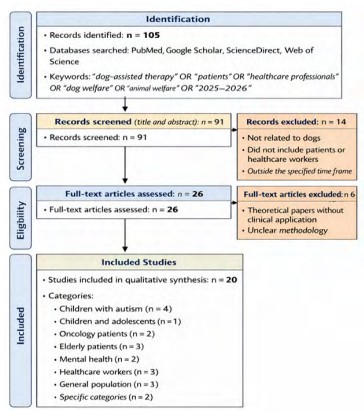
methodology: identification (n = 105), screening (n = 91), eligibility
assessment (n = 36), and final inclusion (n = 20). Included studies
involved children with autism (n = 4), children and adolescents (n =
1), oncology patients (n = 2), elderly patients (n = 3), individuals with
mental health disorders (n = 2), healthcare professionals (n = 3), the
general population (n = 3), and specific categories such as palliative
care, chronic pain, cardiovascular rehabilitation, and special education
(n = 2). The results show that dog-assisted therapy contributes
to reduced stress and anxiety, improved emotional regulation,
enhanced social skills, and better quality of life across different age
groups. Among healthcare professionals, dog-assisted interventions
were associated with reduced burnout and increased psychological
resilience. Dog-assisted therapy has a significant positive effect
on patients and healthcare professionals, with the need for further
research and integration into multidisciplinary teams. In the context
of Bosnia and Herzegovina, this form of therapy is underdeveloped,
and no studies were identified in internationally indexed databases,
indicating a research gap and the need for further development and
implementation of this method in the healthcare system.
References
Downloads
Published
Issue
Section
License
Copyright (c) 2026 Amina Lučkin

This work is licensed under a Creative Commons Attribution 4.0 International License.