Morphometrics of heart of the foetal dromedary
DOI:
https://doi.org/10.51607/22331360.2024.73.3.225Keywords:
Dromedary, foetal, heart, grooves, morphometryAbstract
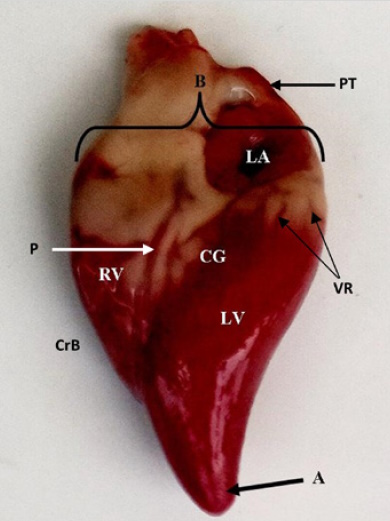
The present study provides an anatomical account of the morphometry of heart of prenatal camel. For this purpose, 15 normal fresh hearts were randomly obtained from different fetuses collected from Maiduguri central abattoir. The fetuses were divided into three different growth periods i.e., first (2-4 months), second (4 -7 months), and third (7-10 months) based on their body weight and crown-rump length. The prenatal dromedary heart was grossly observed to be coned-like with flattened base and nearly sharp apex. The subepicardial blood vessels showed corresponding development with each quarter of the pregnancy. The heart weight showed no significant increase during the second growth period (p>0.05), while an extremely significant increases (p<0.001) were observed during the third growth period. The dimension of the prenatal dromedary heart presented a significant increase (p<0.05) during the second growth period, while an extremely significant increase (p<0.001) was observed during the third growth period in all the fetuses. This increase indicates that there was more embryogenesis of the heart during the third growth period of the prenatal dromedary. It was concluded that the length of posterior border base to apex of prenatal dromedary is higher in length than anterior border base.
References
Downloads
Published
Issue
Section
License
Copyright (c) 2024 Alhaji Zubairu Jaji Gambo (Author); Ibrahim Alhaji Girgiri; Shaibu Mohammed Atabo, Baba Gana Gambo, Adamu Saleh Saidu, Faruku Da'u, Ahmed Yahaya (Author)

This work is licensed under a Creative Commons Attribution 4.0 International License.