Haematological and cytokine responses of Arbor Acre broilers and two Nigerian indigenous chicken genotypes to experimental Eimeria tenella infection
DOI:
https://doi.org/10.51607/22331360.2026.75.2.139Keywords:
Eimeria tenella, coccidiosis, chicken genotype, haematology, cytokine response, tolerance, resilience, genetic resistanceAbstract
Genetic background influences host responses to avian coccidiosis;
however, comparative pathological and immune-haematological data
for Nigerian indigenous chickens remain limited. This study investigated
mortality, haematological alterations, and systemic interferon-gamma
(IFN-γ) and interleukin-10 (IL-10) responses following experimental
Eimeria tenella infection in Arbor Acre broiler, frizzle-feathered,
and normal-feathered chickens. Ninety-day-old chicks (n = 30 per
genotype) were reared under controlled conditions and confirmed
coccidia-free at 19 days of age. Birds were allocated to infected (n =
15 per genotype) and uninfected control groups (n = 15 per genotype).
Clinical signs and mortality were monitored, while haematological
indices and serum cytokine levels were assessed at 5, 7, and 10 days
post-infection (dpi). Mortality was highest in Arbor Acre broilers
(40.0%), intermediate in the Normal feathered (26.67%) and lowest in
the Frizzle-feathered (20.0%) chickens. Infection induced significant
reductions in packed cell volume, haemoglobin concentration, and
red blood cell counts, most pronounced at 7 dpi, consistent with
haemorrhagic anaemia, with the most severe changes observed in
broilers. Total white blood cell and heterophil counts increased across
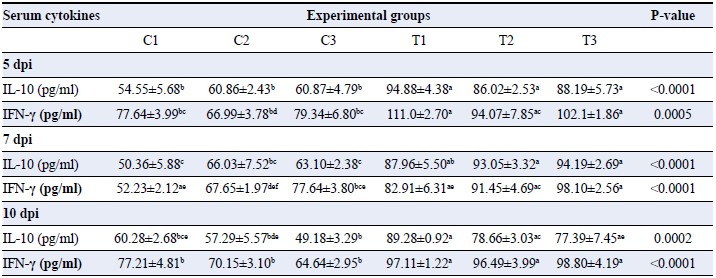
genotypes, indicating a systemic inflammatory response. Serum IFN-γ
and IL-10 concentrations were significantly elevated in infected birds at
all sampling points but did not differ among genotypes. These findings
suggest that genotype-dependent differences in E. tenella infection are
expressed primarily through mortality and haematological pathology
rather than systemic IFN-γ or IL-10 responses. The lower mortality
and less pronounced haematological alterations observed in Nigerian
indigenous chickens may indicate a greater degree of tolerance to
caecal coccidiosis, although further studies are required to confirm the
mechanisms underlying this response. Further studies incorporating
caecal histopathology, local cytokine expression, and genetic analyses
are recommended to clarify mechanisms underlying genotype-related
variation in disease outcome.
References
Downloads
Published
Issue
Section
License
Copyright (c) 2026 Geado Agishi; Sunday Blessing Oladele, Isa Danladi Jatau, James Enam Samson (Author)

This work is licensed under a Creative Commons Attribution 4.0 International License.