Craniometrical characteristics of the Uda and Yankasa breeds of sheep (Ovis aries)
DOI:
https://doi.org/10.51607/22331360.2026.75.1.51Keywords:
Craniometrics, osteometry, sheep, Uda, YankasaAbstract
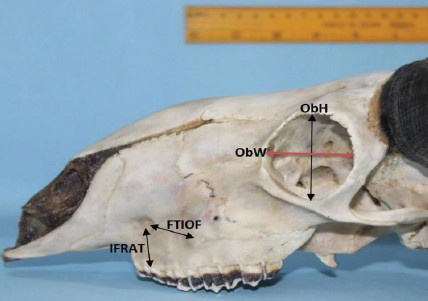
This study aimed to examine and compare the skull osteometric characteristic of the Uda and Yankasa breeds of sheep. A total of 10 skulls of indigenous sheep breeds, comprising five Uda and five Yankasa rams aged between 12 and 18 months, were used for this study. The samples were obtained from Bauchi Metropolis, Bauchi State, Nigeria and transported to the Gross Anatomy laboratory, Department of Veterinary Anatomy, University of Maiduguri, Borno State, for bone processing. The bones were processed using hot water maceration and soft tissue removal techniques. About 39 cranial and mandibular measurements were identified. Comparative analysis of dorsal, caudal, ventral, lateral, and mandibular parameters revealed no statistically significant differences (p > 0.05) between Uda and Yankasa breeds across most measurements. Osteometric findings revealed that viscerocranial length parameters such as INL, VCrL, NL, IOL, MDL, and IISL were slightly higher in Yankasa than Uda. However, neurocranial length-related parameters such as NCrL, ChL, and HPL were slightly higher in Uda than Yankasa. Yankasa also exhibited wider skull profiles, as reflected in IZW, HPW, ChW, IMDAW, NW and NCWLB though not statistically significant. This study provides valuable osteometric data on Uda and Yankasa sheep breeds for taxonomic classification, evolutionary studies, and veterinary clinical applications such as regional anesthesia and surgical procedures involving the head.
References
Downloads
Published
Issue
Section
License
Copyright (c) 2026 Baba Gana Gambo, Muhammad Khalid, Ali Musa Wulgo, Yagana Bukar Majama, Ibrahim Alhaji Girgiri, Waziri Alhaji Kachamai, Ahmed Yahaya

This work is licensed under a Creative Commons Attribution 4.0 International License.