Renal alterations after single application of dinuclear ruthenium(II) Schiff-base complex in Swiss albino mice
DOI:
https://doi.org/10.51607/22331360.2026.75.1.63Keywords:
Histology, kidney, mouse, ruthenium, toxicologyAbstract
Ruthenium complexes represent a relatively new generation of
metal-based substances that are increasingly investigated as potential
chemotherapeutic agents. The aim of this study was to evaluate and
quantify the extent of injury of a single dose of a dinuclear ruthenium(II)
Schiff-base complex on mouse kidneys using stereological and
morphometric approaches. Adult (8–10 weeks old) Swiss albino
mice of both sexes were used. Two experimental groups received
intraperitoneal injections of the dinuclear ruthenium(II) Schiff-base
complex at doses of 25 mg/kg and 175 mg/kg, respectively, while
the control group received vehicle (DMSO) only. After a 14-day
observation period, animals were sacrificed, and both kidneys were
excised for gross measurements (mass and volume) and histological
processing. Quantitative and qualitative light microscopy analyses
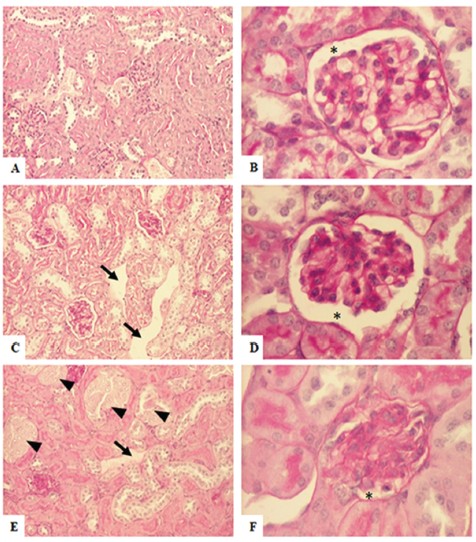
were performed, and the results were statistically evaluated. Low-dose
treatment resulted in increased kidney volume, enlargement of renal
corpuscles and Bowman’s spaces, and tubular dilation compared to
controls. In contrast, high-dose treatment induced decreased kidney
mass, reduced corpuscular and tubular parameters, and increased
tubular cellularity relative to both the low-dose and control groups.
Also, high-dose exposure was associated with a higher incidence of
atypical tubules. Treatment with a low dose of the ruthenium complex
induced mild, potentially reversible alterations in renal corpuscles
and proximal tubules, whereas high-dose exposure caused atrophic
and possibly irreversible changes, suggesting dose-dependent
nephrotoxicity.
References
Downloads
Published
Issue
Section
License
Copyright (c) 2026 Samra Čustović, Višnja Muzika, Dina Kapić, Esad Ćosović, Maida Šahinović, Adnan Zahirović, Emira Kahrović

This work is licensed under a Creative Commons Attribution 4.0 International License.