Temporal alterations in plasma oxidative stress and antioxidant defence in experimentally induced hypothyroid and hyperthyroid rats
DOI:
https://doi.org/10.51607/22331360.2026.75.2.114Keywords:
8-OHdG, antioxidant enzymes, hyperthyroidism, hypothyroidism, lipid peroxidation, nitric oxide, ratAbstract
The plasma oxidant-antioxidant response to chronic hypothyroidism
and hyperthyroidism was evaluated in rats across three cross-sectional
sampling points. Forty-nine male Wistar rats were used. Seven were
sampled on day 0 to establish baseline values, and the remaining 42
received standard drinking water (control), 0.05% propylthiouracil
(PTU), or 0.0012% L-thyroxine (L-T4) for six weeks (n = 14 per
group). Blood was sampled on day 0 (baseline), week 3, and week
6 for serum thyroid hormones (TSH, TT3, TT4, fT3, fT4) and
plasma TBARS, NO, 8-OHdG, SOD, catalase (CAT), GSH-Px, total
glutathione (GSH), and total antioxidant status (TAS). Data were
analysed using one-way ANOVA with Tukey’s HSD post-hoc test.
Hormone profiles confirmed model induction. Body weight decreased
in both treatment groups by week 6, with hypophagia in hypothyroid
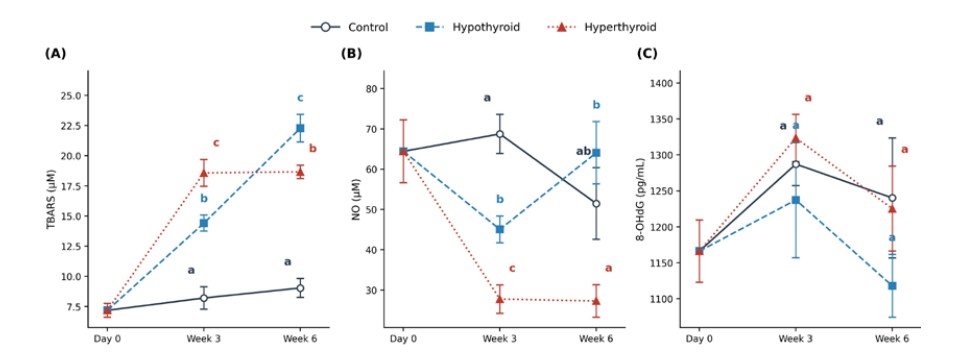
and hyperphagia in hyperthyroid rats (p < 0.001). Plasma TBARS
levels increased in both states and peaked in hypothyroid rats at week
6. Plasma NO levels decreased at week 3 and remained suppressed in
hyperthyroid rats. 8-OHdG was unchanged. SOD increased in both
treatment groups, while CAT showed a non-significant elevation
trend in hypothyroid rats at week 6. GSH-Px and GSH were lowest
in hypothyroid rats. TAS declined over time in both treatment groups.
Both dysthyroid states drive sustained plasma lipid peroxidation
with partial antioxidant compensation. The persistent NO reduction
in hyperthyroidism suggests early vascular vulnerability warranting
further study.
References
Downloads
Published
Issue
Section
License
Copyright (c) 2026 Sinan Kandir, Tufan Keçeci

This work is licensed under a Creative Commons Attribution 4.0 International License.